Isometric City 3D Vector Illustration Guide
Visualizing urban environments has never been more accessible or versatile than it is today. An isometric city 3d vector illustration offers a unique perspective that bridges the gap between technical architectural drawings and engaging artistic renderings. Unlike traditional perspective drawings where objects shrink as they recede into the distance, isometric projections maintain consistent scale. This creates a clean, organized, and highly readable view of complex structures. For designers, marketers, and content creators, this style provides a powerful tool to communicate ideas about urban planning, real estate, gaming, and infrastructure without the visual clutter of realistic photography.
Understanding the Isometric Aesthetic
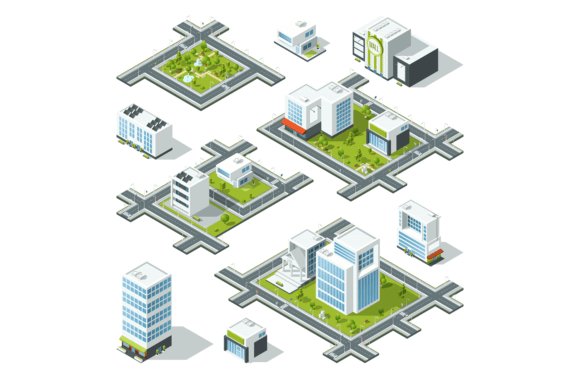
The charm of an isometric city 3d vector illustration with office buildings, skyscrapers, trees and bushes on the street lies in its geometric precision. Every vertical line remains parallel, and horizontal lines are drawn at thirty-degree angles. This specific angle allows viewers to see three sides of an object simultaneously: the top, front, and side. It is a pseudo-3D effect that feels dimensional yet remains flat enough to be easily manipulated in graphic design software.
When you look at a model of urban areas with buildings rendered in this style, you notice an immediate sense of order. The lack of vanishing points means that every element, from a tiny bush to a towering skyscraper, retains its clarity. This makes it ideal for infographics where data needs to be overlaid on maps or where specific features of a city layout must be highlighted without distortion. The aesthetic is modern, clean, and universally understood, making it a favorite among tech companies and urban planners alike.
Why Choose Vector Formats Like EPS?
One of the most critical decisions when acquiring or creating these assets is choosing the right file format. You will often see these designs offered as City 3d buildings design EPS, JPG files. Understanding the difference is vital for professional results.
- EPS (Encapsulated PostScript): This is a vector format. It uses mathematical equations to define shapes rather than pixels. This means you can scale an isometric city illustration from the size of a business card to a billboard without losing any quality. It also allows you to edit individual elements, such as changing the color of a roof or moving a tree, provided you have the right software.
- JPG (Joint Photographic Experts Group): This is a raster format made of pixels. While JPGs are easy to use and compatible with almost every device, they cannot be scaled up without becoming blurry. They are best used for final outputs like web banners or social media posts where editing is not required.
For professionals who need flexibility, the EPS format is indispensable. It ensures that your isometric city 3d vector illustration remains crisp and editable, saving time and resources in the long run.
Practical Applications Across Industries
The versatility of isometric urban models extends far beyond simple decoration. Here is how different professionals utilize these assets to solve real-world problems.
Urban Planning and Real Estate
Developers and city planners use these illustrations to present proposed projects to stakeholders. A detailed model of urban areas with buildings helps non-experts visualize how new constructions will fit into the existing landscape. By including trees and bushes on the street, designers can emphasize green initiatives and livability, which are crucial selling points for modern residential complexes.
Digital Marketing and Web Design
In the digital space, isometric graphics are incredibly popular for landing pages and app interfaces. They add depth and interest without slowing down load times, especially when optimized correctly. A startup might use an isometric city 3d vector illustration to represent their logistics network, showing how their service connects different parts of a metropolis. The clean lines and bright colors align well with modern UI/UX trends, guiding the user’s eye through the narrative of the brand.
Gaming and Education
Many simulation games rely on isometric views because they provide a strategic overview of the environment. Educators also benefit from this style when teaching geography or civics. A simplified map of a city with labeled zones helps students understand urban density, traffic flow, and public services without getting overwhelmed by photographic realism.
Key Elements of a Compelling Design
Creating or selecting a high-quality isometric city 3d vector illustration with office buildings, skyscrapers requires attention to detail. The balance between built structures and natural elements is key. Skyscrapers should vary in height and design to create a dynamic skyline, while street-level details like parks, benches, and vehicles add life to the scene.
Color palettes play a significant role in setting the mood. Soft pastels might suggest a friendly, community-focused neighborhood, while bold, high-contrast colors could indicate a bustling financial district. Consistency in lighting and shadow direction is also essential to maintain the illusion of three-dimensionality. Without consistent shadows, the image may look flat and disjointed.
Considerations Before You Start
If you are new to working with these graphics, keep a few practical tips in mind. First, consider your end goal. If you need to print large formats, always prioritize vector files like EPS. If you are only posting on social media, a high-resolution JPG may suffice and be easier to handle.
Second, think about customization. Do you need to change the branding colors to match your company? If so, ensure the vector file is well-layered and organized. Poorly constructed vector files can be frustrating to edit, with grouped elements that are difficult to separate.
Finally, remember that less is often more. An isometric city 3d vector illustration can become cluttered if too many details are packed into a small space. Leave some negative space to allow the viewer’s eye to rest and to accommodate text or call-to-action buttons if used in marketing materials.
By understanding the strengths of isometric design and choosing the right formats, you can leverage these visuals to enhance communication, boost engagement, and present complex urban concepts with clarity and style. Whether you are designing a website, planning a development, or creating educational content, this timeless artistic approach offers a perfect blend of form and function.