Building Digital Landscapes with City Park or Forest Isometric 3d Trees
In the evolving landscape of digital design, the demand for assets that balance aesthetic appeal with technical efficiency has never been higher. Designers, game developers, and urban planners increasingly turn to isometric perspectives to visualize complex environments in a digestible, stylized format. At the heart of these visualizations lies a critical component: vegetation. The City Park or Forest Isometric 3d Trees collection represents a specialized resource designed to meet this need, offering a comprehensive suite of nature elements that bridge the gap between raw vector data and polished, ready-to-use graphics.
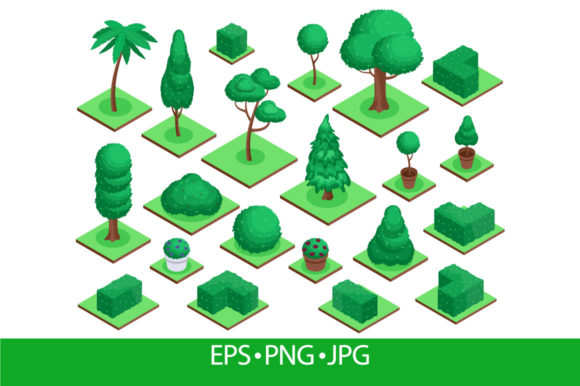
This asset set is not merely a compilation of clip art; it is a structured library intended for professionals who require consistency, scalability, and versatility. By providing spruce, palm trees, garden green fences, and various landscape elements in multiple formats including EPS, PNG, and JPEG, the collection addresses the diverse workflow requirements of modern creators. Understanding the practical value of such a resource requires looking beyond the surface aesthetics to examine how these elements function within real-world projects.
The Versatility of Isometric Nature Elements
Isometric design relies on a specific geometric projection where the three axes appear equally foreshortened, creating a sense of depth without the distortion of perspective vanishing points. Achieving this look manually for every leaf and branch is time-consuming and prone to inconsistency. The City Park or Forest Isometric 3d Trees set alleviates this burden by providing pre-rendered and vector-based assets that adhere strictly to isometric principles.
The inclusion of both city park and forest variants is a significant strength. Urban designs often require manicured bushes, flower pots, and structured green fences, while naturalistic scenes demand the organic irregularity of spruce trees and dense undergrowth. Having both styles within a single ecosystem allows designers to create hybrid environments, such as a suburban edge where a managed park transitions into a wilder forest zone. This flexibility ensures that the visual language remains coherent even as the environment changes.
Technical Quality and Format Flexibility
One of the most compelling aspects of this collection is its multi-format delivery. Professional workflows vary significantly depending on the end goal. For print media, large-scale posters, or further customization in illustration software, the EPS (Encapsulated PostScript) files are indispensable. Vector formats allow for infinite scalability without loss of quality, enabling designers to adjust colors, modify shapes, or integrate the trees into larger vector compositions seamlessly.
Conversely, digital applications such as web design, mobile app interfaces, or game development often prioritize speed and ease of implementation. Here, the PNG files with transparent backgrounds prove essential. They can be dragged and dropped directly into layout tools or game engines, saving hours of manual masking and rendering. The availability of JPEG formats also caters to quick previews or contexts where transparency is not required, ensuring that the assets are accessible regardless of the user’s technical constraints.
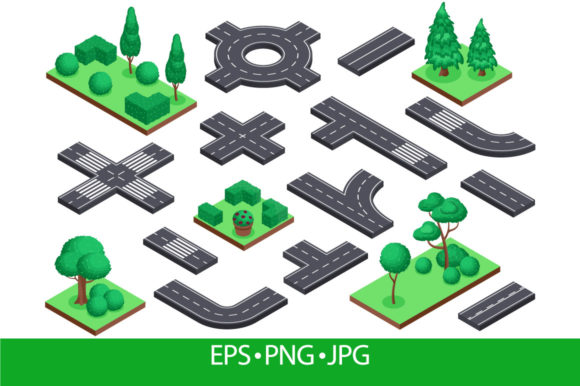
The quality of the "grass cubes" and base elements deserves specific mention. In isometric design, the ground plane is as important as the objects placed upon it. These textured cubes provide a consistent foundation, ensuring that trees and bushes do not appear to float awkwardly. This attention to foundational detail enhances the overall realism and cohesion of the final composition.
Practical Applications for Professionals
Who benefits most from the City Park or Forest Isometric 3d Trees? The audience is broad, ranging from indie game developers to corporate marketers. For game developers, particularly those working on simulation or strategy games, these assets offer a rapid prototyping solution. Instead of modeling every tree from scratch, developers can use these pre-made sprites to build levels quickly, focusing their resources on gameplay mechanics rather than environmental art.
Urban planners and architects also find value in these visuals. When presenting concepts to clients or the public, photorealistic renders can sometimes be overwhelming or misleading. Isometric illustrations provide a clear, schematic view of how green spaces integrate with infrastructure. The inclusion of specific elements like garden green fences and flower pots allows for detailed landscaping plans that are easy to understand and visually engaging.
Marketers and content creators benefit from the aesthetic consistency. Infographics regarding ecology, sustainability, or outdoor activities often require symbolic representations of nature. Using a cohesive set of isometric trees ensures that the visual tone remains professional and unified, avoiding the cluttered look that results from mixing disparate stock images.
Evaluating Usability and Workflow Integration
Integrating new assets into an existing workflow always carries a learning curve. However, the logical organization of this set minimizes friction. The separation of elements into categories—such as spruce, palm, bushes, and flowers—allows for quick retrieval. This categorization is crucial when working under tight deadlines, as it reduces the time spent searching for the right asset.
Furthermore, the consistency in lighting and shading across the entire set is a notable quality indicator. Inconsistent light sources can break the illusion of a 3D space. These assets appear to share a common light direction, which means they can be combined freely without requiring additional editing to match shadows or highlights. This reliability is a significant time-saver, allowing creators to focus on composition rather than correction.
However, users should be aware of certain limitations. While the vector files offer customization, they are still stylized representations. They may not suit projects requiring hyper-realism or photographic accuracy. Additionally, while the variety is substantial, highly specific botanical accuracy may be limited. The goal here is visual clarity and stylistic harmony, not scientific illustration. Designers working on educational materials that require precise species identification should verify the botanical details before use.
Long-Term Value and Ecological Representation
Beyond immediate utility, the City Park or Forest Isometric 3d Trees set holds long-term value due to its relevance to contemporary themes. As awareness of outdoor ecology and green urban planning grows, the demand for high-quality nature visuals increases. This collection allows creators to participate in these conversations effectively, providing the tools needed to visualize sustainable cities, biodiversity initiatives, and peaceful natural retreats.
The durability of vector-based assets also contributes to their long-term worth. Unlike raster images that may become pixelated as display resolutions increase, EPS files remain crisp on any screen or print medium. This future-proofs the investment, ensuring that the assets remain usable as technology evolves.
Final Considerations for Buyers
Before purchasing or downloading, consider your specific project needs. If you are building a complex game engine, ensure that the PNG resolutions meet your performance requirements. If you are creating print materials, verify that your design software supports EPS imports comfortably. For most general design purposes, however, this collection offers a robust, flexible, and professionally crafted solution.
The City Park or Forest Isometric 3d Trees set stands out as a practical tool for anyone looking to enhance their digital landscapes. It combines artistic style with technical precision, offering a reliable foundation for a wide range of creative projects. By providing a diverse array of elements in multiple formats, it respects the varied workflows of modern professionals, making it a valuable addition to any designer’s toolkit.
Ultimately, the value of this resource lies in its ability to streamline the creative process. It removes the technical barriers of creating isometric nature elements from scratch, allowing creators to focus on storytelling, user experience, and visual impact. Whether you are designing a mobile game, an urban planning proposal, or an ecological infographic, these assets provide the necessary building blocks to bring your vision to life with clarity and style.